Skill Management Ecosystem
Engineering a bi-directional mapping system to harmonize global skill taxonomies and external market data across Deloitte's global operations.
Challenge
Fragmented skill taxonomies across internal DST records and external market libraries created days of manual mapping work.
Solution
A bi-directional Translation Tables module with active upload validation, dual-view relational engine, and a full governance queue.
Impact
100% data integrity since launch. Mapping reduced from days to minutes. Admins self-correct with contextual tooltips.
The Gatekeeper
Backend Logic · Data Validation · Error HandlingBefore touching the UI, I mapped the backend validation logic for data ingestion — moving the system from “Passive Uploading” to “Active Validation.” The system intercepts every CSV upload with a 3-point check:
- —Uniqueness: Checking IDs against existing DST and Market Library records
- —Structural Integrity: Identifying rows missing mandatory metadata (Category/Source)
- —Mapping Conflicts: Flagging skills already linked to other hosts to prevent many-to-many data corruption
Design Decision
Instead of a generic Error message, I designed an Upload Log that highlights specific row-level errors, allowing users to correct data before it hits the production database.
// Key Feature — Contextual Guidance System
I integrated an error-reporting layer that speaks admin language, not system language. Recognizing that technical error codes are a barrier for non-technical users, every flagged row-level error is paired with an interactive tooltip — hovering a highlighted error like “Duplicate Skill ID” surfaces a plain-language explanation of exactly what went wrong.
This turns a dead-end error message into guided troubleshooting, reducing reliance on IT support tickets and helping data get corrected with precision.
The Relational Engine
Information Architecture · Relational Data Modeling · Mental Model AlignmentCore complexity: managing One-to-Many relationships. One internal Deloitte skill (Host) can represent dozens of external variations (Outsource). Solution: a Dual-View Toggle:
- —View A — Host Perspective: Centers on the internal Deloitte skill, showing all external aliases mapped to it
- —View B — Outsource Perspective: Centers on the external source, ensuring every skill links to exactly one parent
// Key Feature
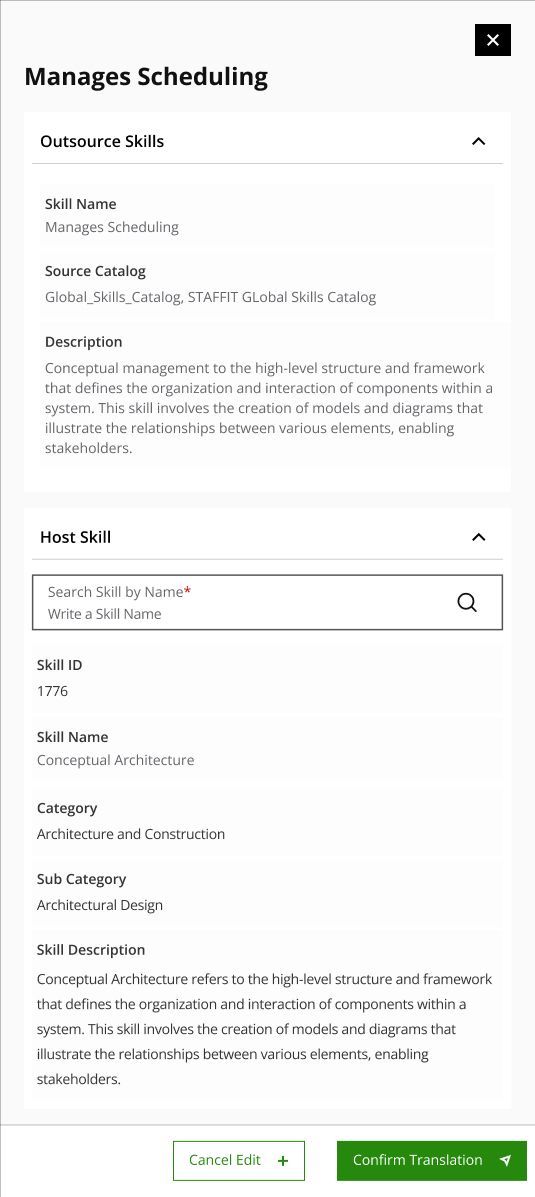
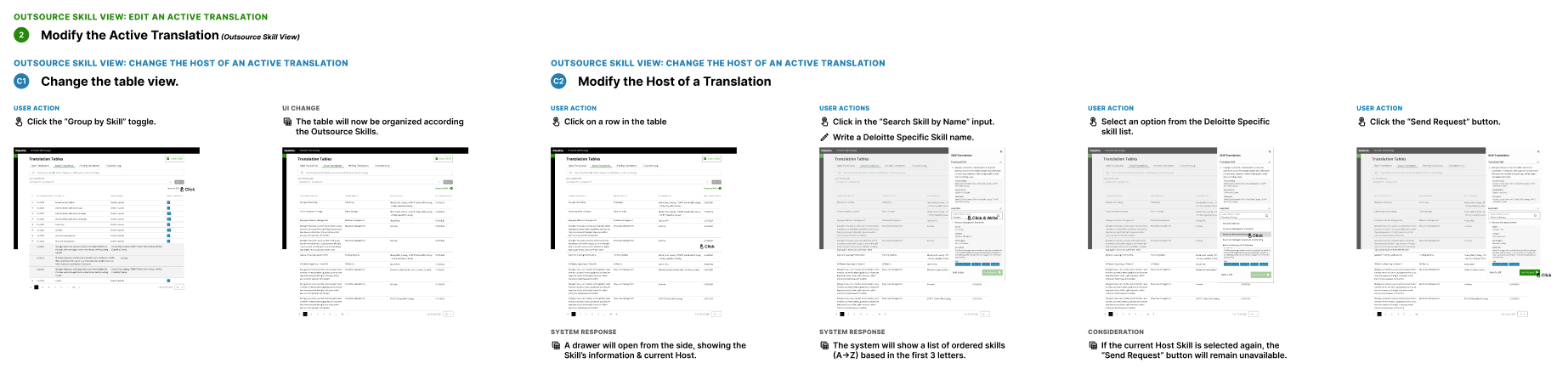
The Remap Drawer allows users to move an Outsource skill from one Host to another — triggering automatic updates across Pending Translations and Translation Logs to maintain a perfect audit trail.
Actionable Drawers
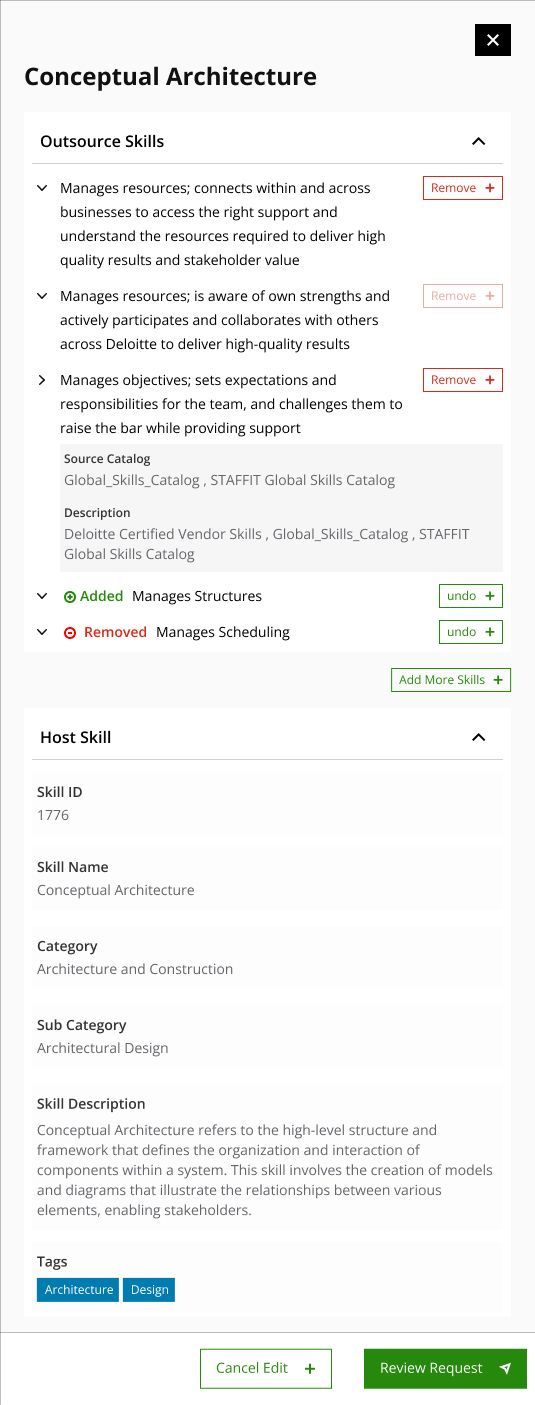
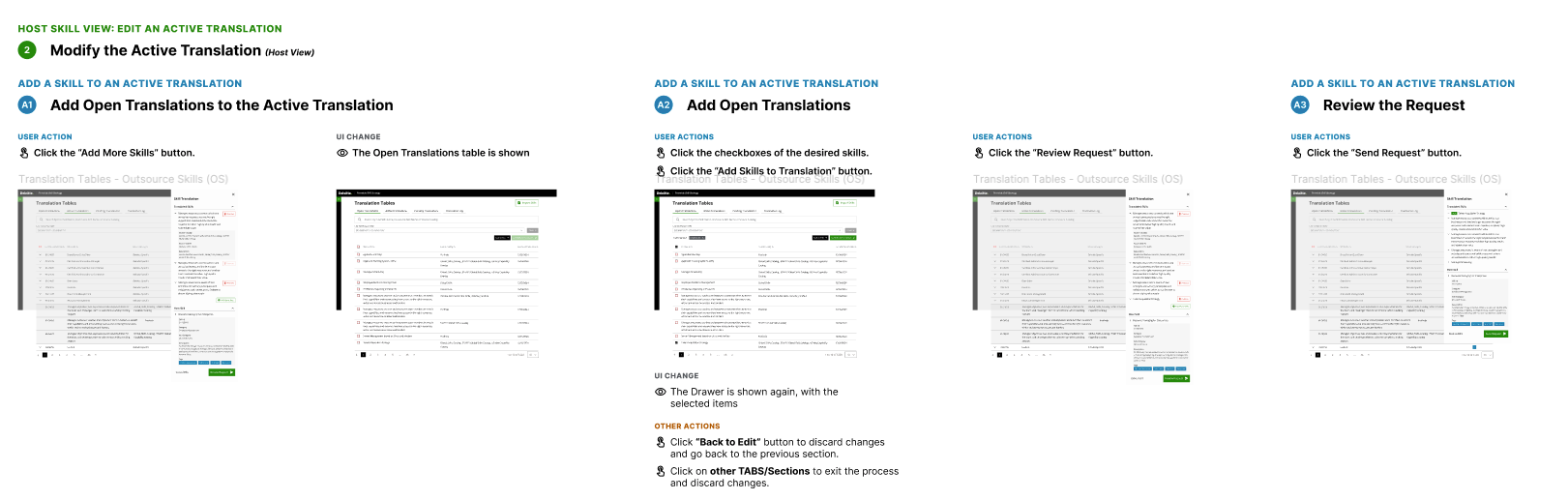
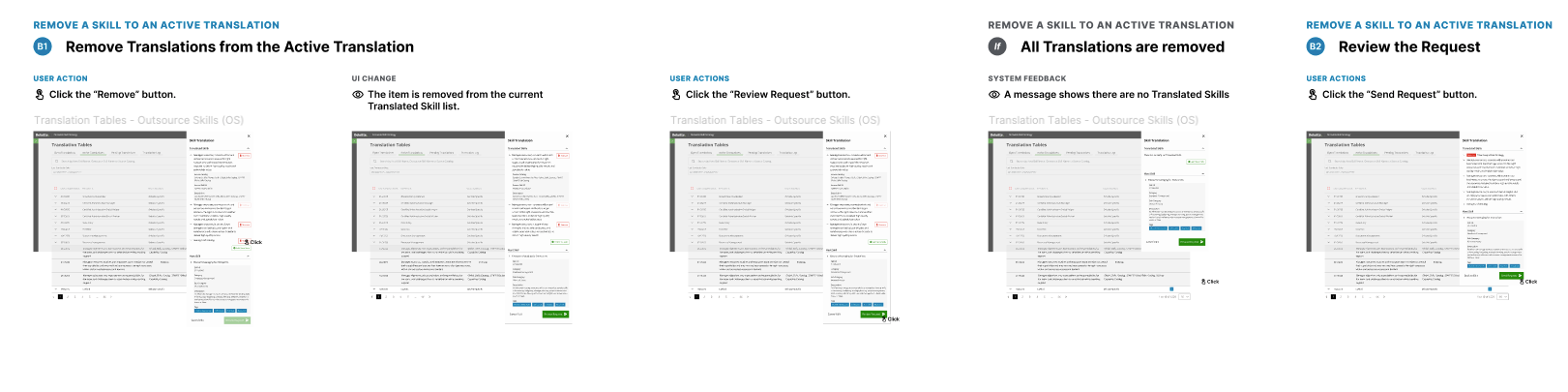
To ensure the mapping remains dynamic and accurate, I designed specialized Contextual Drawers for the editing process. Within these drawers, users can perform high-precision actions without losing their place in the main table. I engineered the interface to support:
- — Add Translation
- — Remove Translation
- — Edit Host
System Governance & Traceability
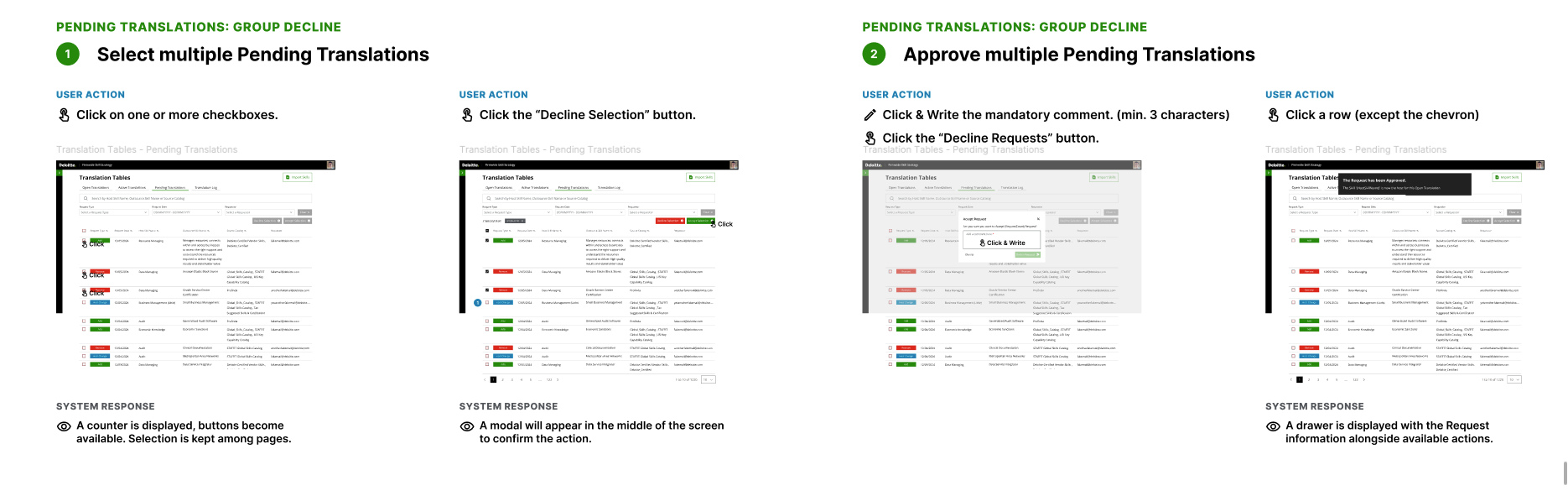
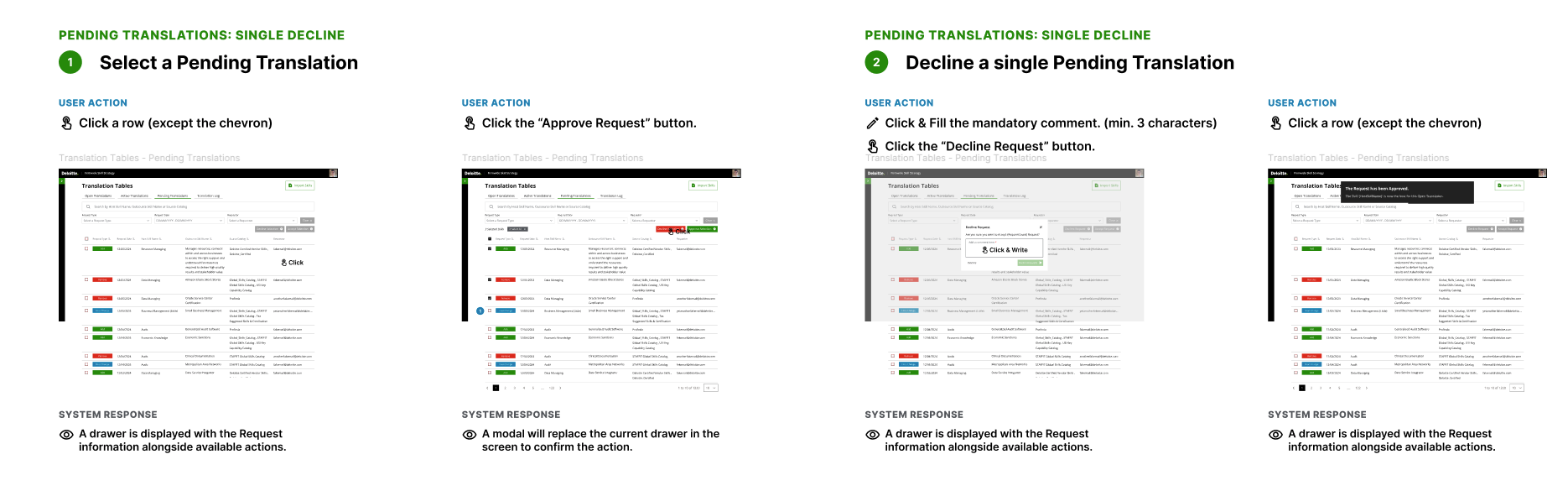
Governance · Compliance · System-Wide SynchronizationEvery mapping request — whether adding, removing, or reassigning a skill — enters the Pending Translationsqueue as a proposal, not a change. Nothing touches the live “Source of Truth” until an Admin reviews it.
Approving a request pushes the change through immediately. Declining it requires the Admin to enter a reason — the skill stays exactly as it was, and that reason is attached directly to the request. Both outcomes are written to the Translation Log, so requesters can check back, see whether their request was accepted or rejected, and read the decline comment directly. A rejected request isn’t a dead end — it’s feedback the requester can act on to submit a corrected one.
// Key Feature
The Translation Log records every relationship change — move, reason, timestamp — creating a complete, immutable audit trail.
Results
100%
Data Integrity
Zero corruption since launch. Pre-check validation blocks thousands of duplicate or orphaned entries.
— Chapter 01, The Gatekeeper
3-Point
Validation Logic
Every incoming record passes through Uniqueness, Structural Integrity, and Mapping Conflict checks before reaching production.
— Chapter 01, The Gatekeeper
Days → Minutes
Mapping Time
Manual taxonomy mapping collapsed from a multi-day process to a matter of minutes.
— Chapter 02 / Chapter 03
In Enterprise SaaS, UX is a balance between User Empathy — reducing admin fatigue — and Data Architecture — managing complex relational logic. I turned a rigid data-entry tool into a system that thinks in relationships, not rows.
Solving something like this for your team?
Book an intro call →